
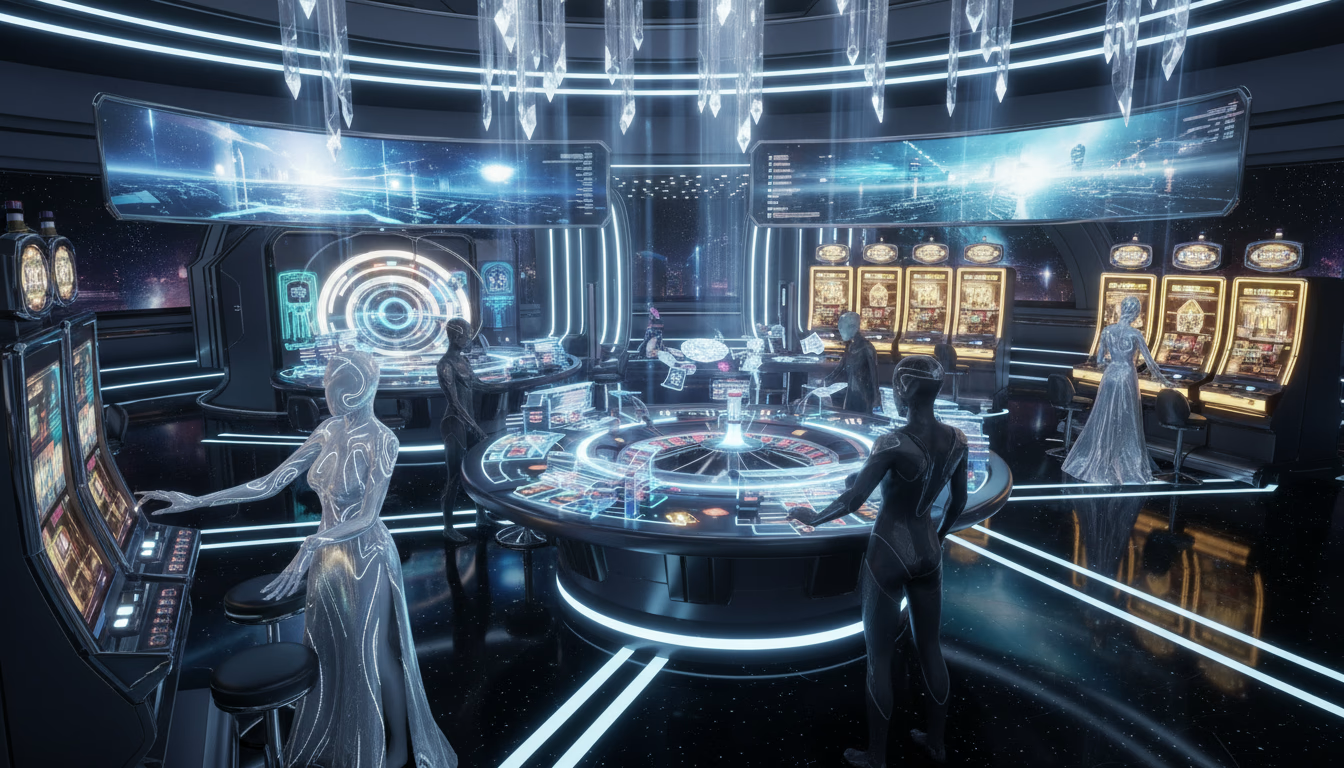
“The casino of the future will be in virtual reality” has been a confident headline for years. Some of it is true: VR hardware is real and widely sold. Much of the rest is still marketing or speculation. This article separates the two, explains what “immersive” real-money play looks like today, and lists the specific risks and checks that apply before you try any VR gambling product.
The hardware is real
Consumer VR headsets are an established product category. The best known are Meta’s Quest line (Quest 2, Quest 3 and the cheaper Quest 3S), Sony’s PlayStation VR2, released in 2023, and Apple’s Vision Pro, launched in 2024 and sold as a “spatial computer” rather than a gaming device. They track head and hand movement, and some models also track the eyes. So the technical side of “sitting at a virtual table” is not science fiction.
VR casino apps: mostly play money
What has existed on headsets so far is mainly social or play-money casino and poker apps: you get virtual chips, sit at a table with other people’s avatars, chat and play, but you cannot cash out. Real-money VR gambling is a niche, for two simple reasons:
- Licensing. A real-money product needs a gambling licence that covers the players it accepts, plus identity checks, payments and responsible-gambling controls inside the VR environment.
- Platform rules. Headset app stores have their own policies on real-money gambling apps, which limits where such apps can be distributed.
So when you see a “VR casino” advertised, the first question is whether it involves real money at all, and if so, who licenses it.
What “immersive” real-money play looks like today
Most of what online casinos currently call immersive happens on an ordinary screen:
- Live-dealer games: real dealers, real cards and wheels, streamed from a studio, with bets placed through an on-screen interface.
- 3D and animated slots that run in a mobile or desktop browser.
- Game-show formats and crash games, where many players watch the same round in real time.
| Format | What it is | Real money? | Status |
|---|---|---|---|
| VR casino and poker apps on headsets | Avatar tables in a virtual room | Mostly play money or social chips | Exists, niche |
| Live-dealer streaming | Real table filmed in a studio, browser interface | Yes, at licensed operators | Widespread |
| 3D slots in the browser | Animated RNG games on phone or PC | Yes, at licensed operators | Widespread |
| “Metaverse” and crypto-land casinos | Casinos built on virtual land in blockchain worlds | Sometimes, often in crypto | Speculative; licensing often unclear |
| Haptic gloves and suits | Touch feedback for virtual objects | Not in mainstream gambling | Experimental |
Speculation to treat with care
Metaverse casinos. Virtual worlds in which users buy “land” and build venues have hosted casino-style projects, often paid in cryptocurrency. Treat them carefully: it is frequently unclear who operates them, which licence applies and how disputes would be handled.
Haptics. Gloves or vests that let you “feel” chips or cards exist in labs and for some games, but they are not part of mainstream real-money gambling.
Big forecasts. Articles promising that VR will soon replace online casinos rarely show verifiable data. This site does not publish market-size or adoption figures for VR gambling, because no reliable source supports a specific number.
Where Betx1000 stands
Betx1000 is a browser-based site: there is no app in the app stores, and on the pages checked the operator publishes no VR product and says nothing about VR plans. Its closest format to a sense of “presence” is the live casino, where dealers are streamed in real time. Games come from many third-party providers (129 according to the operator’s site at the time of checking, including NetEnt, Novomatic, Nolimit City and Playson), and crash games such as Aviator and JetX are part of the selection. The licence comes from Anjouan; details and how to verify it are on our licensing page.
Note: the operator rotates numbered mirror domains (betx1000.com forwards to a numbered domain). Any “Betx1000 VR” app or website you might see advertised is not something the operator itself publishes on the pages checked, so treat such offers with suspicion and only trust addresses the root domain forwards to.
The risks that come with immersion
- Longer sessions and time distortion. The more absorbing an environment, the easier it is to lose track of time. In a headset you do not even see a clock or a phone notification unless the app shows one.
- Perception of wins. Sounds, lights and celebrations shape how wins and losses feel; in a 3D environment that effect can be stronger. Our article on slot sounds and losses disguised as wins explains the mechanism.
- Motion sickness and fatigue. Many people feel nausea, eye strain or headaches in VR, especially in long sessions, which is not a good state for money decisions.
- Privacy. Headsets collect motion data, room mapping and, on some models, eye-tracking data. Combined with gambling accounts, that is sensitive information; read the privacy policy of both the headset platform and the app.
- Energy and data. Streaming high-quality video and 3D content uses more energy and bandwidth; see our article on where online gambling’s energy goes.
Checklist before trying any VR gambling product
- Who holds the licence? Find the licence number and check it on the regulator’s own register, not just a logo in the footer. For Anjouan licences the official tool is the verify-a-licence page.
- Real money or play money? Play-money chips cannot be cashed out; real-money apps must say so clearly and ask for identity checks.
- Read the terms: withdrawal rules, maximum win, bonus restrictions and what happens to your balance if the app or platform shuts down.
- Spending and time controls: can you set deposit limits, session reminders or self-exclusion inside the app? If not, set them elsewhere, for example through your bank.
- Keep sessions short and take the headset off at fixed intervals. More general habits are on our tips page.
Play responsibly (18+). Gambling is entertainment that costs money, whatever the screen or headset. Before playing, check your account settings or ask support about deposit limits and self-exclusion; an Anjouan licence does not impose rules as strict as regulators such as Malta or the UK. Blocking software such as Gamban or BetBlocker and your bank’s gambling block can help. Free support: GamCare (UK) 0808 8020 133, gamcare.org.uk; international online help: gamblingtherapy.org.
Frequently asked questions
Can you gamble for real money in VR today?
Only in a few niche products. Most casino and poker apps on VR headsets use play money or social chips, while real-money immersive play mostly happens through live-dealer streams and 3D games in a browser.
Does Betx1000 have a VR casino or app?
No. On the pages checked the operator publishes no VR product and has no app in the app stores; it runs as a mobile and desktop browser site, with a live casino as its most immersive format.
Are metaverse casinos safe?
They should be treated with care. It is often unclear who operates them, which licence applies and how disputes are handled, so check the licence on the regulator’s own register before depositing anything.
What are the main risks of gambling in VR?
Longer sessions and loss of time awareness, stronger emotional effects of wins and near-misses, motion sickness and fatigue, and privacy concerns because headsets collect motion and sometimes eye-tracking data.